Johann Jakob Froberger: Notes and Commentary

Johann Jakob Froberger was a German Baroque composer, keyboard virtuoso, and organist. He was among the most famous composers of the era and influenced practically every major composer in Europe by developing the genre of keyboard suite and contributing greatly to the exchange of musical traditions through his many travels. He is also remembered for his highly idiomatic and personal descriptive harpsichord pieces, which are among the earliest known examples of program music.

Only two of Froberger’s many compositions were published during his lifetime, but his music was very widely spread in manuscript copies and he was one of the very few 17th-century composers who were never entirely forgotten. His works were studied in the 18th century (although perhaps not very extensively, and certainly without influence on the emerging Classical style) by Handel, Bach and, extraordinarily, even Mozart and Beethoven. He lived from May 1616 to May 1667.—Excerpted from Wikipedia

Johann Jakob Froberger Books and Music
More on Froberger
Back to home page

Johann Jakob Froberger: Complete Works

Access complete list.

Libro secundo, 1649 (101–106)
Toccata in A minor
Toccata in D minor
Toccata in G major
Toccata in C major
Toccata da sonarsi alla Leuatione in D minor (elevation toccata)
Toccata da sonarsi alla Leuatione in G minor (elevation toccata)

Libro quarto, 1656 (107–112)
Toccata in G major
Toccata in E minor
Toccata in C major
Toccata in F major
Toccata in E minor (elevation toccata)
Toccata in A minor

Fantasias (201–206)
Fantasia Sopra Ut, Re, Mi, Fa, So, La in C major
Fantasia in A minor
Fantasia in F major
Fantasia Sopra Sol, La, Re in G major
Fantasia in A minor
Fantasia in A minor

Canzonas (301–306)
Canzona in D minor
Canzona in G minor
Canzona in F major
Canzona in G major
Canzona in C major
Canzona in A minor

Johann Jakob Froberger Books and Music
More on Froberger
Back to home page

Johann Jakob Froberger: Books and Music

Selected Books

Organ Works (sheet music)
Dover, 2012
$17.36 on Amazon

organ

Selected Music

curios Diverse Curiose Partite Per Cembalo (2000), 1 CD

alena Suites & Toccatas (2012), 1 CD

fro-keyboard The Complete Keyboard Works, Vol. 1 (2005), 1 CD

More Johann Jakob Froberger music

More on Froberger
Back to home page

Johann Jakob Froberger, 1616-1667

Froberger

Selected Recordings

6 Toccatas for Cembalo

Ricercar No. 5

Canzona 5 in G

Selected Sheet Music

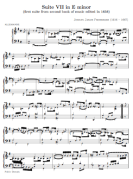
Partita in E minor
Partitia

Source: IMSLP.org

Showcase Piece

Keyboard works

Notes and Commentary

Johann Jakob Froberger was a German Baroque composer, keyboard virtuoso, and organist. He was among the most famous composers of the era and influenced practically every major composer in Europe by developing the genre of keyboard suite and contributing greatly to the exchange of musical traditions through his many travels. He is also remembered for his highly idiomatic and personal descriptive harpsichord pieces, which are among the earliest known examples of program music.

Only two of Froberger’s many compositions were published during his lifetime, but his music was very widely spread in manuscript copies and he was one of the very few 17th-century composers who were never entirely forgotten. His works were studied in the 18th century (although perhaps not very extensively, and certainly without influence on the emerging Classical style) by Handel, Bach and, extraordinarily, even Mozart and Beethoven. He lived from May 1616 to May 1667.—Excerpted from Wikipedia

Books and Music

Selected Books

Organ Works (sheet music)
Dover, 2012
$17.36 on Amazon

organ

Selected Music

curios Diverse Curiose Partite Per Cembalo (2000), 1 CD

alena Suites & Toccatas (2012), 1 CD

fro-keyboard The Complete Keyboard Works, Vol. 1 (2005), 1 CD

More Johann Jakob Froberger music

Complete Works

Access complete list.

Libro secundo, 1649 (101–106)
Toccata in A minor
Toccata in D minor
Toccata in G major
Toccata in C major
Toccata da sonarsi alla Leuatione in D minor (elevation toccata)
Toccata da sonarsi alla Leuatione in G minor (elevation toccata)

Libro quarto, 1656 (107–112)
Toccata in G major
Toccata in E minor
Toccata in C major
Toccata in F major
Toccata in E minor (elevation toccata)
Toccata in A minor

Fantasias (201–206)
Fantasia Sopra Ut, Re, Mi, Fa, So, La in C major
Fantasia in A minor
Fantasia in F major
Fantasia Sopra Sol, La, Re in G major
Fantasia in A minor
Fantasia in A minor

Canzonas (301–306)
Canzona in D minor
Canzona in G minor
Canzona in F major
Canzona in G major
Canzona in C major
Canzona in A minor

Back to home page

50 Great Composers, 1 Not-so-Great Compilation

Goulding There are so many guides to classical music it’s hard to know which ones have anything different to say. Phil Goulding’s guide, released in 1995, has the virtue of the author not saying much at all. Instead, he lets the talking be done by others—mostly great composers themselves. “I remain a nonexpert,” Goulding says. “Ninety-five percent of [the book] comes from [what I gleaned in] used bookstores, new bookstores, and assorted public libraries.”

There’s certainly a lot of charm in Goulding’s pre-Internet methodology for learning about classical music. (He says he knew nothing about it before starting his project, which took him seven years.) Basically, he culled commentary from the world’s great composers and from musicologists and others and determined his list of the 50 greatest composers of all time based on who the composers themselves and other experts held in high esteem. Review It should come as little surprise that at the top of the list are three names widely considered the titans of music: Bach, Mozart, and Beethoven. Indeed, Goulding calls these three the immortals, and says that their place at the top is so secure that it could never be tolerated, by anybody anywhere, that someone should try to demote them.

He then lists eight demigods, all either Classical or Romantic composers with the exception of Handel, and then he lists two additional categories: composers of genius and artists of a high order.

As you can guess from his labels, Goulding is quite the wit, and indeed the introductory part of the book is fun to read. The rest of the book is a fairly standard catalogue of the 50 composers , their principal works, and commentary on where their works fit in the context of musical development over the centuries.

Goulding is trying to cover roughly 500 years of music, so it’s hard to give due attention to everyone who deserves it. But he seems to put too much weight on Romatic-era composers, who comprise 27 of the 50 greats, compared to the Baroque era, the period of eight of the greats. Really?

Of the Baroque greats, you have everyone you would expect to have: Bach, Monetverdi, Couperin, Vivaldi, Telemann, Rameau, Handel, and Gluck (a Baroque-Classical transition figure). But there are so many who are not on the list.

You have to wonder if Goulding gave too much weight to Romantic-era composers simply because he had available to him so much more information on them. Does it really make sense to have Camille Saint Saens, the Romatic-era French organist, on the list while Arcangelo Corelli isn’t? Or what about Modest Mussorgsky, a Russian Romatic composer whose music is noted for—what? Okay, he tried to compose music in opposition to convention. So, his music is rough, dissonant. But is his contribution to music really that much greater than, again, Corelli’s, whose work was pivotal for the violin and for the idea that instrumentals could occupy as important a place as vocal works?

Of course, that’s the problem with any compilation. No one will ever be happy with who’s included and who’s not. For the fan of Baroque music, Goulding’s book just doesn’t offer that much. Bach sits at the top of the heap, at No.1, the first of the three immortals, but when more than half of your top 50 are Romantics, covering about 85 years of your 500-year period, than you have to think your compiler spent too much time in old and new book stores and in libraries reading about composers and not enough time listening to music.—Nabob, On Baroque

Classical Music
The 50 Greatest Composers and Their 1,000 Greatest Works
Ballantine Books, 1995
636 pages
Phil G. Goulding
$15.82 on Amazon

More book reviews
Back to Point Against Point
Back to home page

Johann Adolph Hasse: Notes and Commentary

Johann Adolph Hasse was an 18th-century German composer, singer, and teacher of music. Immensely popular in his time, Hasse was best known for his prolific operatic output, though he also composed a considerable quantity of sacred music. He was a pivotal figure in the development of opera seria and 18th-century music.

Despite his popularity as a figure at the very forefront of 18th-century serious Italian opera, after his death Hasse’s reputation vastly declined and his music lay mostly unperformed (with the exception of some of his sacred works, which were revived now and again in Germany). In particular, his operas sank without trace and revival only begun as the 20th century approached its end.

In his day, Hasse’s style was noted primarily for his lyricism and sense of melody.
Careful choice of key was a crucial factor in Hasse’s style, with certain emotions usually marked out by certain key choices. Amorous feelings were expressed by A, for instance, while for expressions of aristocratic nobility Hasse used C and B flat; on the other hand, his supernatural and fear-inducing music usually went into the keys of C and F minor. Most of his arias begin in the major, switching only to minor for the B section before returning to major for the da capo. As his career developed his arias grew much longer but a lyrical sense was still his overriding target. He lived from March 1699 to December 16, 1783.—Excerpted from Wikipedia

Johann Adolph Hasse Books and Music
More on Johann Adolph Hasse
Back to home page