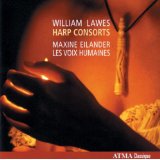
William Lawes was an English composer and musician. He was apprenticed to the composer John Coprario, which brought him into contact with Charles, Prince of Wales, at an early age. Both William and his elder brother Henry received court appointments after Charles succeeded to the British throne as Charles I. William was appointed “musician in ordinary for lutes and voices” in 1635 but had been writing music for the court prior to this.
Lawes spent all his adult life in Charles’s employ. He composed secular music and songs for court masques, as well as sacred anthems and motets for Charles’s private worship. He is most remembered today for his sublime viol consort suites for between three and six players and his lyra viol music. His use of counterpoint and fugue and his tendency to juxtapose bizarre, spine-tingling themes next to pastoral ones in these works made them disfavoured in the centuries after his death; they have only become widely available in recent years. He lived from April 1602 to September 24, 1645, “casually shot” during the rout of the Royalists at Rowton Heath, near Chester.”—Excerpted from Wikipedia
Air and Fantasias for 6 Viols
Airs and Fantasia for 4 Viols
Airs and Fantasia for 5 Viols
Airs for 3 Viols
Royal Consort
Set a 5 in C major, (No.5)
Set a 5 in G minor
Set a 6 in C major, Lefkowitz No.2, Pinto VII
Set a 6 in F major, Lefkowitz No.5, Pinto VIII
Suite No.1 for 2 Viols and Organ
Suite No.1 for 3 Viols and Organ
Suite No.2 for 2 Viols and Organ
Suite No.2 for 3 Viols and Organ
Suite No.3 for 2 Viols and Organ
Suite No.3 for 3 Viols and Organ
Suite No.4 for 2 Viols and Organ
Suite No.4 for 3 Viols and Organ
Suite No.5 for 2 Viols and Organ
Suite No.5 for 3 Viols and Organ
Suite No.6 for 2 Viols and Organ
Suite No.6 for 3 Viols and Organ
Suite No.7 for 2 Viols and Organ
Suite No.7 for 3 Viols and Organ
Suite No.8 for 2 Viols and Organ
Suite No.8 for 3 Viols and Organ
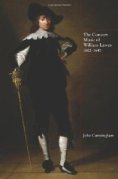
“A thorough and highly authoritative account, which will no doubt long remain essential reading for anyone interested not only in Lawes but also in his close contemporaries.”—Peter Phillips on Amazon
William Lawes was an English composer and musician. He was apprenticed to the composer John Coprario, which brought him into contact with Charles, Prince of Wales, at an early age. Both William and his elder brother Henry received court appointments after Charles succeeded to the British throne as Charles I. William was appointed “musician in ordinary for lutes and voices” in 1635 but had been writing music for the court prior to this.
Lawes spent all his adult life in Charles’s employ. He composed secular music and songs for court masques, as well as sacred anthems and motets for Charles’s private worship. He is most remembered today for his sublime viol consort suites for between three and six players and his lyra viol music. His use of counterpoint and fugue and his tendency to juxtapose bizarre, spine-tingling themes next to pastoral ones in these works made them disfavoured in the centuries after his death; they have only become widely available in recent years. He lived from April 1602 to September 24, 1645, “casually shot” during the rout of the Royalists at Rowton Heath, near Chester.”—Excerpted from Wikipedia
“A thorough and highly authoritative account, which will no doubt long remain essential reading for anyone interested not only in Lawes but also in his close contemporaries.”—Peter Phillips on Amazon
Air and Fantasias for 6 Viols
Airs and Fantasia for 4 Viols
Airs and Fantasia for 5 Viols
Airs for 3 Viols
Royal Consort
Set a 5 in C major, (No.5)
Set a 5 in G minor
Set a 6 in C major, Lefkowitz No.2, Pinto VII
Set a 6 in F major, Lefkowitz No.5, Pinto VIII
Suite No.1 for 2 Viols and Organ
Suite No.1 for 3 Viols and Organ
Suite No.2 for 2 Viols and Organ
Suite No.2 for 3 Viols and Organ
Suite No.3 for 2 Viols and Organ
Suite No.3 for 3 Viols and Organ
Suite No.4 for 2 Viols and Organ
Suite No.4 for 3 Viols and Organ
Suite No.5 for 2 Viols and Organ
Suite No.5 for 3 Viols and Organ
Suite No.6 for 2 Viols and Organ
Suite No.6 for 3 Viols and Organ
Suite No.7 for 2 Viols and Organ
Suite No.7 for 3 Viols and Organ
Suite No.8 for 2 Viols and Organ
Suite No.8 for 3 Viols and Organ
“To Giovanni Battista Pergolesi goes the distinction and the achievement of having been the first to establish the traditions that would govern the writing of opera buffa for more than a century. Opera buffa liked to deal with everyday people in everyday settings, involved in everyday farcical episodes, in contrast to opera seria, which favored mythological subjects, characters, and exploits.”—David Ewen,The Complete Book of Classical Music
Pergolesi was an Italian composer, violinist and organist. His opera seria, Il prigionier superbo, contained the two act buffa intermezzo, La Serva Padrona (The Servant Mistress), which became a very popular work separate from the main opera. When it was performed in Paris in 1752, it prompted the so-called Querelle des Bouffons (“quarrel of the comic actors”) between supporters of serious French opera by the likes of Jean-Baptiste Lully and Jean-Philippe Rameau and supporters of new Italian comic opera. Pergolesi was held up as a model of the Italian style during this quarrel, which divided Paris’s musical community for two years.
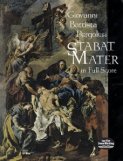
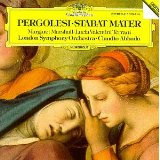
Pergolesi also wrote sacred music, including a Mass in F and his Magnificat in C major. It is his Stabat Mater (1736), however, for female soprano, female alto, string orchestra and basso continuo, which is his best known sacred work. While classical in scope, the opening section of the setting demonstrates Pergolesi’s mastery of the Italian baroque durezze e ligature style, characterized by numerous suspensions over a faster, conjunct bassline. The work remained popular, becoming the most frequently printed work of the 18th century, and being arranged by a number of other composers, including Johann Sebastian Bach, who used it as the basis for his cantata Tilge, Höchster, meine Sünden (Root out my sins, Highest One). Pergolesi also wrote a number of secular instrumental works, including a violin sonata and a violin concerto.
He lived from January 4, 1710, to March 16, 1736, dying at age 28 from tuberculosis.—Excerpted from Wikipedia
Most well-known works: Opera Il prigionier superbo, including two act buffa intermezzo, La Serva Padrona, 1733 La conversione e morte di San Guglielmo, 1731 Lo frate ‘nnamorato, 1732, L’Olimpiade, 1735 Il Flaminio, 1735 Sacred
Mass in F
Magnificat in C major.
Stabat Mater, 1736
Works in alphabetical order (not a complete list): Adriano in Siria Allegro in E major Chi non ode, e chi non vede Il Flaminio Flute Concerto in G major Lo frate ‘nnamorato Harpsichord Sonata in A major Harpsichord Sonata in D major Livietta e Tracollo Maestro di musica L’Olimpiade Orfeo Organ Sonata in F major Salve Regina a due in C minor Salve Regina a due in F minor Salve regina in C minor Salve Regina in E minor Salve regina in F minor Segreto tormento La serva padrona Sinfonia for Cello and Continuo Stabat mater Tre giorni son che Nina Verbum Christi di croce



 , 2-CD set
 , 1 CD
 , 1 CD
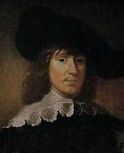




 , 1 CD
 , MP3
, MP3
 , 3-CD set
 On Baroque
You must be logged in to post a comment.