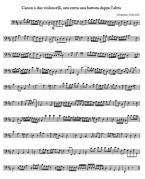
Domenico Gabrielli was an Italian Baroque composer and virtuoso cello player. He was apparently not related to the Venetian Gabrielis. Born in Bologna, he worked in the orchestra of the church of San Petronio and was also a member and for some time president (principe) of the Accademia Filarmonica of Bologna. During the 1680s he also worked as a musician at the court of Duke Francesco II d’Este of Modena. Gabrielli wrote several operas as well as instrumental and vocal church works. He is especially notable as the composer of some of the earliest attested works for solo cello (two sonatas for cello and basso continuo, a group of seven ricercari for unaccompanied cello, and a canon for two cellos). Among his contemporaries, his own virtuoso performances on this instrument earned him the nickname Mingain (or Minghino) dal viulunzeel, a dialect form meaning “Dominic of the cello.” He lived from April 15, 1651, or October 19, 1659, to July 10, 1690.—Excerpted from Wikipedia
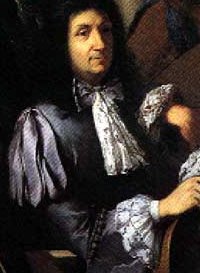
Marin Marais was a French composer and viol player. He studied composition with Jean-Baptiste Lully, often conducting his operas. He was hired as a musician in 1676 to the royal court of Versailles, and in 1679 was appointed ordinaire de la chambre du roy pour la viole, a title he kept until 1725.
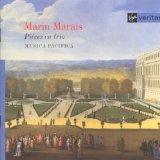
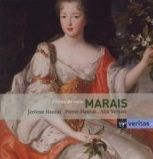
He was considered a master of the basse de viol, and the leading French composer of music for the instrument. He wrote five books of Pièces de viole (1686–1725) for the instrument, generally suites with basso continuo, and for these he was remembered in later years as he who “founded and firmly established the empire of the viol.” His other works include a book of Pièces en trio (1692) and four operas (1693–1709), Alcyone (1706) being noted for its tempest scene.
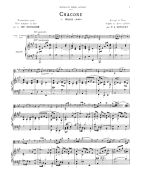
Titon du Tillet included Marais in Le Parnasse françois, making the following comments on two of his pieces,”La Gamme” and “Le Labyrinthe,” perhaps inspired by the labyrinth of Versailles: “A piece from his fourth book entitled ‘The Labyrinth,’ which passes through various keys, strikes various dissonances and notes the uncertainty of a man caught in a labyrinth through serious and then quick passages; he comes out of it happily and finishes with a gracious and natural chaconne. But he surprised musical connoisseurs even more successfully with his pieces called ‘La Gamme’ [The Scale], which is a piece de symphonie that imperceptibly ascends the steps of the octave; one then descends, thereby going through harmonious songs and melodious tones, the various sounds of music.”
Marais is credited with being one of the earliest composers of program music. His work “The Bladder-Stone Operation,” for viola da gamba and harpsichord, includes composer’s annotations such as “The patient is bound with silken cords” and “He screameth.” The title has often been interpreted as “The Gall-Bladder Operation,” but that surgery was not performed until the late 19th century. Urinary bladder surgery to remove stones was already a medical specialty in Paris in the 17th century. Marais lived from May 1, 1656, to August 15, 1728.—Excerpted from Wikipedia
Pieces for 1 and 2 viols, Book I (August 20, 1686, only solo viols, March 1, 1689, first published with associated basso continuo) Pieces en trio pour les flutes, violon, et dessus de viole (published on December 20, 1692, and dedicated to Marie-Anne Roland) Pieces for 1 and 2 viols, Book II (1701), including 32 couplets on “Les folies d’Espagne” Pièces de violes, Book III (1711) Pieces for 1 and 3 viols, Book IV (1717; includes the famous “Suitte d’un Goût Étranger.”) La gamme et autres morceaux de symphonie (1723, includes “La Gamme en forme d’un petit Opéra,” “Sonate à la Maresienne,” and “Sonnerie de Ste-Geneviève du Mont-de-Paris”) Pièces de violes, Book V (1725)
145 Pieces for viol (ca. 1680), about 100 pieces were published in Books I – III
Operas Idylle dramatique of 1686 (music lost) Alcide (1693, in collaboration with Louis Lully) Ariane et Bacchus (1696) Alcyone (premiered on February 18, 1706) Sémélé (1709) Pantomime des pages (with Louis Lully, music lost)
Sacred works Te Deum (1701) for the recovery of the Dauphin (lost) Motet Domine salvum fac regem (1701) for the recovery of the Dauphin (lost)—Excerpted from Wikipedia
Performance Practice and Technique in Marin Marais’ Pieces De Viole
Umi Research, 1986
Deborah A. Teplow
“This book is excellent. It is well written, clear and it has fine musical examples. It is a MUST buy for any player of the viola da gamba who wishes to perform the basse de viole literature of the French Baroque. It will also be a great resource for anyone studying Baroque performance practices.”—Deborah C. Jones on Amazon
Marin Marais was a French composer and viol player. He studied composition with Jean-Baptiste Lully, often conducting his operas. He was hired as a musician in 1676 to the royal court of Versailles, and in 1679 was appointed ordinaire de la chambre du roy pour la viole, a title he kept until 1725.
He was considered a master of the basse de viol, and the leading French composer of music for the instrument. He wrote five books of Pièces de viole (1686–1725) for the instrument, generally suites with basso continuo, and for these he was remembered in later years as he who “founded and firmly established the empire of the viol.” His other works include a book of Pièces en trio (1692) and four operas (1693–1709), Alcyone (1706) being noted for its tempest scene.
Titon du Tillet included Marais in Le Parnasse françois, making the following comments on two of his pieces,”La Gamme” and “Le Labyrinthe,” perhaps inspired by the labyrinth of Versailles: “A piece from his fourth book entitled ‘The Labyrinth,’ which passes through various keys, strikes various dissonances and notes the uncertainty of a man caught in a labyrinth through serious and then quick passages; he comes out of it happily and finishes with a gracious and natural chaconne. But he surprised musical connoisseurs even more successfully with his pieces called ‘La Gamme’ [The Scale], which is a piece de symphonie that imperceptibly ascends the steps of the octave; one then descends, thereby going through harmonious songs and melodious tones, the various sounds of music.”
Marais is credited with being one of the earliest composers of program music. His work “The Bladder-Stone Operation,” for viola da gamba and harpsichord, includes composer’s annotations such as “The patient is bound with silken cords” and “He screameth.” The title has often been interpreted as “The Gall-Bladder Operation,” but that surgery was not performed until the late 19th century. Urinary bladder surgery to remove stones was already a medical specialty in Paris in the 17th century. Marais lived from May 1, 1656, to August 15, 1728.—Excerpted from Wikipedia
Performance Practice and Technique in Marin Marais’ Pieces De Viole
Umi Research, 1986
Deborah A. Teplow
“This book is excellent. It is well written, clear and it has fine musical examples. It is a MUST buy for any player of the viola da gamba who wishes to perform the basse de viole literature of the French Baroque. It will also be a great resource for anyone studying Baroque performance practices.”—Deborah C. Jones on Amazon
Pieces for 1 and 2 viols, Book I (August 20, 1686, only solo viols, March 1, 1689, first published with associated basso continuo) Pieces en trio pour les flutes, violon, et dessus de viole (published on December 20, 1692, and dedicated to Marie-Anne Roland) Pieces for 1 and 2 viols, Book II (1701), including 32 couplets on “Les folies d’Espagne” Pièces de violes, Book III (1711) Pieces for 1 and 3 viols, Book IV (1717; includes the famous “Suitte d’un Goût Étranger.”) La gamme et autres morceaux de symphonie (1723, includes “La Gamme en forme d’un petit Opéra,” “Sonate à la Maresienne,” and “Sonnerie de Ste-Geneviève du Mont-de-Paris”) Pièces de violes, Book V (1725)
145 Pieces for viol (ca. 1680), about 100 pieces were published in Books I – III
Operas Idylle dramatique of 1686 (music lost) Alcide (1693, in collaboration with Louis Lully) Ariane et Bacchus (1696) Alcyone (premiered on February 18, 1706) Sémélé (1709) Pantomime des pages (with Louis Lully, music lost)
Sacred works Te Deum (1701) for the recovery of the Dauphin (lost) Motet Domine salvum fac regem (1701) for the recovery of the Dauphin (lost)—Excerpted from Wikipedia


 S. Sigismondo re de Borgogna (2008)
 La Nascita del Violoncello (2012)
 Complete Cello Works (2012)



 , 2-CD set
 , 2-CD set
 , 1 CD


 On Baroque
You must be logged in to post a comment.