Messe Vidi turbam magnam
Cantate Domino
De ore prudentis
Gregorio Allegri Books and Music
More on Allegri
Back to home page
Messe Vidi turbam magnam
Cantate Domino
De ore prudentis
Gregorio Allegri Books and Music
More on Allegri
Back to home page
À l’aube, Miserere
Gregorio Allegri Books and Music
More on Allegri
Back to home page
Gregorio Allegri was an Italian composer of the Roman School and brother of Domenico Allegri, also a composer of note. As a benefice in the cathedral of Fermo, Allegri composed a large number of motets and other sacred music, which, being brought to the notice of Pope Urban VIII, obtained for him an appointment in the choir of the Sistine Chapel at Rome as a contralto. He held this from 1629 until his death.
Among Allegri’s musical compositions were two volumes of concerti for five voices published in 1618 and 1619; two volumes of motets for six voices published in 1621; an edition of a four-part sinfonia; five masses; two settings of the Lamentations of Jeremiah; and numerous motets which were not published in his lifetime. He was one of the earliest composers for stringed instruments. Most of Allegri’s published music, especially the instrumental music, is in the progressive early Baroque concertato style. However, his work for the Sistine Chapel is descended from the Palestrina style, and in some cases strips even this refined, simple style of all ornament. He is credited with the earliest string quartet.
By far the most well known and regarded piece of music composed by Allegri is the Miserere mei, Deus, a setting of Vulgate Psalm 50. It is written for two choirs, the one of five and the other of four voices, and has obtained considerable celebrity. One of the choirs sings a simple fauxbordon based on the original plainsong chant for the Tonus peregrinus; the other choir sings a similar fauxbordon with pre-existing elaborations and the use of cadenzas. The Miserere has for many years been sung annually during Holy Week in the Sistine Chapel. Many have cited this work as an example of the stile antico (old style) or prima pratica (first practice). However, its constant use of the dominant seventh chord and its emphasis on polychoral techniques certainly put it out of the range of prima pratica. A more accurate comparison would be to the works of Giovanni Gabrieli.
The Miserere is one of the most often-recorded examples of late Renaissance music, although it was actually written during the chronological confines of the Baroque era; in this regard it is representative of the music of the Roman School of composers, who were stylistically conservative. He lived from 1582 to February 17, 1652. —Excerpted from Wikipedia
Gregorio Allegri Books and Music
More on Allegri
Back to home page
Among Allegri’s musical compositions were two volumes of concerti for five voices published in 1618 and 1619, two volumes of motets for six voices published in 1621, an edition of a four-part sinfonia, five masses, two settings of the Lamentations of Jeremiah, and numerous motets which were not published in his lifetime. Some surviving works:
Incipit lamentatio
Miserere
Veni Sancte Spiritus
Gregorio Allegri Books and Music
More on Allegri
Back to home page
Selected Books
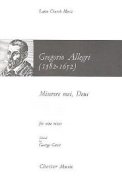
Miserere Mei (sheet music)
Chester Music, 1976
$7.90 on Amazon
Selected Music
 Miserere (2003)
 Catholic Latin Classics (2000)
 Masses & Motets (2012)

Messe Vidi turbam magnam
Cantate Domino
De ore prudentis
Miserere Mei

Source: Erato
À l’aube, Miserere
Gregorio Allegri was an Italian composer of the Roman School and brother of Domenico Allegri, also a composer of note. As a benefice in the cathedral of Fermo, Allegri composed a large number of motets and other sacred music, which, being brought to the notice of Pope Urban VIII, obtained for him an appointment in the choir of the Sistine Chapel at Rome as a contralto. He held this from 1629 until his death.
Among Allegri’s musical compositions were two volumes of concerti for five voices published in 1618 and 1619; two volumes of motets for six voices published in 1621; an edition of a four-part sinfonia; five masses; two settings of the Lamentations of Jeremiah; and numerous motets which were not published in his lifetime. He was one of the earliest composers for stringed instruments. Most of Allegri’s published music, especially the instrumental music, is in the progressive early Baroque concertato style. However, his work for the Sistine Chapel is descended from the Palestrina style, and in some cases strips even this refined, simple style of all ornament. He is credited with the earliest string quartet.
By far the most well known and regarded piece of music composed by Allegri is the Miserere mei, Deus, a setting of Vulgate Psalm 50. It is written for two choirs, the one of five and the other of four voices, and has obtained considerable celebrity. One of the choirs sings a simple fauxbordon based on the original plainsong chant for the Tonus peregrinus; the other choir sings a similar fauxbordon with pre-existing elaborations and the use of cadenzas. The Miserere has for many years been sung annually during Holy Week in the Sistine Chapel. Many have cited this work as an example of the stile antico (old style) or prima pratica (first practice). However, its constant use of the dominant seventh chord and its emphasis on polychoral techniques certainly put it out of the range of prima pratica. A more accurate comparison would be to the works of Giovanni Gabrieli.
The Miserere is one of the most often-recorded examples of late Renaissance music, although it was actually written during the chronological confines of the Baroque era; in this regard it is representative of the music of the Roman School of composers, who were stylistically conservative. He lived from 1582 to February 17, 1652. —Excerpted from Wikipedia
Selected Books
Miserere Mei (sheet music)
Chester Music, 1976
$7.90 on Amazon
Selected Music
 Miserere (2003)
 Catholic Latin Classics (2000)
 Masses & Motets (2012)
Among Allegri’s musical compositions were two volumes of concerti for five voices published in 1618 and 1619, two volumes of motets for six voices published in 1621, an edition of a four-part sinfonia, five masses, two settings of the Lamentations of Jeremiah, and numerous motets which were not published in his lifetime. Some surviving works:
Incipit lamentatio
Miserere
Veni Sancte Spiritus
L’Euridice (complete version)
Tu dormi e’l dolce sonno
Al canto, al ballo, all’ombra
Dunque fra torbide onde (madrigale)
Jacopo Peri was an Italian composer and singer of the transitional period between the Renaissance and Baroque styles, and is often called the inventor of opera. He wrote the first work to be called an opera today, Dafne (around 1597), and also the first opera to have survived to the present day, Euridice (1600). In the 1590s, Peri became associated with Jacopo Corsi, the leading patron of music in Florence. The two of them believed contemporary art was inferior to classical Greek and Roman works, and attempted to recreate Greek tragedy, as they understood it. Their work added to that of the Florentine Camerata of the previous decade, which produced the first experiments in monody, the solo song style over continuo bass which eventually developed into recitative and aria.
Peri and Corsi brought in the poet Ottavio Rinuccini to write a text, and the result, Dafne, though nowadays thought to be a long way from anything the Greeks would have recognised, is seen as the first work in a new form, opera. Rinuccini and Peri next collaborated on Euridice. This was first performed on October 6, 1600, at the Palazzo Pitti. Unlike Dafne, it has survived to the present day (though it is hardly ever staged, and then only as an historical curio). The work made use of recitatives, a new development which went between the arias and choruses and served to move the action along.
Peri produced a number of other operas, often in collaboration with other composers, and also wrote a number of other pieces for various court entertainments. Few of his pieces are performed today, and even by the time of his death his operatic style was looking old-fashioned when compared to the work of relatively younger reformist composers such as Claudio Monteverdi. Peri’s influence on those later composers, however, was large. He lived from August 20, 1561, to August 12, 1633.—Excerpted from Wikipedia


 On Baroque
You must be logged in to post a comment.