Dafne, with Jacopo Corsi
L’Euridice, with Jacopo Corsi
La Flora, with Marco da Gagliano
Other operas
Other pieces for court entertainments
Author Archives: Nabob
Jacopo Peri: Books and Music
Selected Books
Orpheus in the Marketplace
Harvard University Press, 2013
Richard A. Goldthwaite and Tim Carter
$38.77 on Amazon


“Richard Goldthwaite, an economic historian, and Tim Carter, a musicologist, have done much more than write a biography: their investigation exposes the remarkable value of Peri’s private account books and other financial documents as a primary source for an entire period. This record of Peri’s wide-ranging investments and activities in the marketplace enables the first detailed account of the Florentine economy in the late sixteenth and early seventeenth centuries, and also opens a completely new perspective on one of Europe’s principal centers of capitalism.”—From the book description at Michael Shamansky, Bookseller
Selected Music
 Euridice (2000)
 Il Zazzerino (1999)


Jacopo Peri, 1561-1633

Selected Recordings
Tu dormi e’l dolce sonno
Al canto, al ballo, all’ombra
Dunque fra torbide onde (madrigale)
Selected Sheet Music
“Nel puro ardor” from Euridice
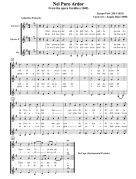
Source: CPDL.org
Showcase Piece
L’Euridice (complete version)
Notes and Commentary
Jacopo Peri was an Italian composer and singer of the transitional period between the Renaissance and Baroque styles, and is often called the inventor of opera. He wrote the first work to be called an opera today, Dafne (around 1597), and also the first opera to have survived to the present day, Euridice (1600). In the 1590s, Peri became associated with Jacopo Corsi, the leading patron of music in Florence. The two of them believed contemporary art was inferior to classical Greek and Roman works, and attempted to recreate Greek tragedy, as they understood it. Their work added to that of the Florentine Camerata of the previous decade, which produced the first experiments in monody, the solo song style over continuo bass which eventually developed into recitative and aria.
Peri and Corsi brought in the poet Ottavio Rinuccini to write a text, and the result, Dafne, though nowadays thought to be a long way from anything the Greeks would have recognised, is seen as the first work in a new form, opera. Rinuccini and Peri next collaborated on Euridice. This was first performed on October 6, 1600, at the Palazzo Pitti. Unlike Dafne, it has survived to the present day (though it is hardly ever staged, and then only as an historical curio). The work made use of recitatives, a new development which went between the arias and choruses and served to move the action along.
Peri produced a number of other operas, often in collaboration with other composers, and also wrote a number of other pieces for various court entertainments. Few of his pieces are performed today, and even by the time of his death his operatic style was looking old-fashioned when compared to the work of relatively younger reformist composers such as Claudio Monteverdi. Peri’s influence on those later composers, however, was large. He lived from August 20, 1561, to August 12, 1633.—Excerpted from Wikipedia
Books and Music
Selected Books
Orpheus in the Marketplace
Harvard University Press, 2013
Richard A. Goldthwaite and Tim Carter
$38.77 on Amazon
“Richard Goldthwaite, an economic historian, and Tim Carter, a musicologist, have done much more than write a biography: their investigation exposes the remarkable value of Peri’s private account books and other financial documents as a primary source for an entire period. This record of Peri’s wide-ranging investments and activities in the marketplace enables the first detailed account of the Florentine economy in the late sixteenth and early seventeenth centuries, and also opens a completely new perspective on one of Europe’s principal centers of capitalism.”—From the book description at Michael Shamansky, Bookseller
Selected Music
Euridice (2000)
Il Zazzerino (1999)
 Opera Omnia I: Madrigali (2010)
Complete Works
Dafne, with Jacopo Corsi
L’Euridice, with Jacopo Corsi
La Flora, with Marco da Gagliano
Other operas
Other pieces for court entertainments
He Knows a Good Time, and It’s Not Opera

Saint-Évremond
From the “unlikely-to-get-season-tickets” department, we introduce you to Charles de Saint-Évremond, whose hedonism didn’t extend to attending opera.
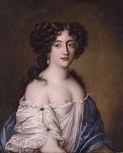
Hortense Mancini
The French essayist and critic Charles de Saint-Évremond knew how to have a good time. After fleeing to England in 1661 to escape prosecution for attacking the Treaty of the Pyrenees, which ended the Franco-Spanish War, he ended up in the embrace of Hortense Mancini–a soft landing to be sure.
Mancini was the most beautiful of five beautiful daughters of Lorenzo Mancini, an Italian Baron. After an ill-conceived marriage with one of the richest (but also one of the most unstable) men in Europe, Mancini found sanctuary under the protection of Charles II and then later James II.
Comfortably ensconced in London, she turned her home into a parlor for artists and writers looking for stimulation, intellectual and otherwise. Of course Saint-Évremond would find his way to her house, and although it’s not clear whether the stimulation he received there was anything other than intellectual, he surely found in Mancini a kindred spirit. Rational moralists both, they eschewed the idea that pleasure is a sin, as long as one’s pleasure does nothing to harm others. And indeed, Mancini developed a reputation, whether fairly or not, for her flings with both men and women.
Given this hedonism, you might think Saint-Évremond would be a lover of opera, which in the mid-1600s was just starting to migrate from Italy to France and England, but if you were to think that, you would be wrong. “The music, in some places, is charming,” he says in a letter to the Duke of Buckingham. “The whole together seems wonderful. But it must be granted me also that this wonderful is very tedious; for where the mind has so little to do, there the senses must of necessity languish. After the first pleasure that surprise gives us, the eyes are taken up, and at length grow weary of being continually fixed upon the same object. . . . The soul, fatigued by a long attention, wherein it finds nothing to affect it, seeks some relief within itself; and the mind, which in vain expected to be entertained with the show, either gives way to idle musing, or is dissatisfied that it has nothing to employ it. In a word, the fatigue is so universal, that everyone wishes himself out of the house; and the only comfort that is left to the poor spectators, is the hope that the show will soon be over.”
Well, this does not sound ike a man who will be getting season tickets anytime soon.
In any case, that was not the whole of Saint-Évremond’s criticism. Indeed, his letter to the Duke goes on at length, during which he mentions works by Monteverdi, Rossi, Cavali, and others, and then finally sums up by calling opera a wretched mix of music and poetry. And yet, he says at last, one should not advertise his distaste for opera, because it’s bad form. So, he advises discretion. “A man runs a risk of having his judgment called in question, if he dares declare his good taste; and I advise others, when they hear any discourse of opera, to keep their knowledge a secret to themselves.” Unless, of course, one is declaring one’s tastes to the Duke.
So, we can be sure that, if ever Saint-Évremond attended opera with Hortense Mancini he did not enjoy it. But he surely enjoyed her company nonetheless.—Nabob, On Baroque
 The excerpts from Saint-Évremond’s letter are from a really terrific book, Music in the Western World: A History in Documents
More about Saint-Évremond
 Works of Charles de Saint-Evremond

More about Hortense Mancini


Let’s Give Leonora Duarte the Hollywood Treatment
 When you think of the great Dutch painter Johannes Vermeer you tend to think of “Girl with a Pearl Earring,” probably his most famous painting. You might remember it was the inspiration of a pretty but underwhelming 2004 film of the same name with Scarlett Johansson and Colin Firth.
But I’m wondering if Hollywood wouldn’t have done better to make a movie about one of Vermeer’s lesser known paintings, “A Lady Seated at a Virginal.” Now that would have made for an intriguing film, because the young lady who is the subject of the painting is reminiscent of Leonora Duarte. 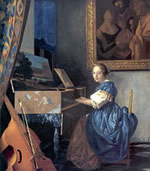
Duarte is an almost completely unknown Flemish composer whose few surviving works are sinfonias of lovely lyricism. It’s remarkable that any of her works have survived, since it was unusual for a woman in the mid-1600s to get her work published professionally and even more unusual if the woman was Jewish, as Duarte was, although her family had renounced their Judaism and converted to Catholicism, in name if not in practice.
It’s not believed that Vermeer personally knew Leonora or her family, but he likely knew of the Duartes through his relationship with Constantijn Huygens, arguably the most influential Dutchman of his time in matters of art and culture and a regular visitor to the Duarte household in Antwerp. In fact, it’s believed that Huygens brokered the purchase of “A Lady Seated at a Virginal” to Leonora’s father, Gaspar, a wealthy merchant and art collector.

Gaspar
Gaspar was a notable musical talent in his own right, as was his wife, and indeed as were all four of the children.
The Duartes were fond of gathering together in the evenings to play music for their guests, making their home on the Meir the place to be. As one English visitor put it, “They make a fyne consort and harmony for luts, viols, virginals and voyces. I doubt not but you will fynde great contentement by hearing them.”
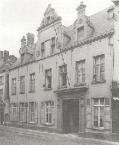
Home on the Meir
Leonora stood out in this musical family because of her talent for composition, which so impressed her father that he had some of her pieces professionally transcribed and published at his own expense.
It’s not certain, but it’s possible English composer John Bull helped Leonora give her music a professional polish by working with her on her writing.

From Duarte’s sinfonia
In any case, Leonora was able to combine her native talent with the latest ideas in Italian and French music because of the rich traffic of visitors from all parts of Europe that regularly made it to the house on the Meir, including Dirk Sweelinck, son of Jan Pieterszoon Sweelinck, the Dutch composer whose work helped mark the transition between the Reniassance and Baroque periods of music.
So, if Leonora wasn’t the subject of Vermeer’s painting she night as well have been, because it depicts the world she lived in. And yet, as a musical talent of considerable gifts, she transcended that world and has given us, as unlikely as it is, the beautiful music of a young Jewish lady at the crossroads of culture at a rich time. That sounds like as great a summer project as any Hollywood filmmaker could wish for.—Nabob On Baroque
Credit to Adelheid Rech at Essential Vermeer and a paper by Victor Tunkel for much of this history.
You can sample Duarte’s music in this short sinfonia:
Two parts of Duarte’s 5-part sinfonia are included in this compilation on Jewish viol music.
 Birds on Fire (2008)
The World Awaits the Next Johann
Musicologists and others have longed tried to unlock the secret of great composers. From where deep within one’s right or left hemisphere does genius originate? Are they born with this talent or do they develop it over time? Does the music tutor at whose chair they sit at a young age make a difference?

Johann
Well, I think the root of musical genius has been staring us in the face all along. It’s all in the name. I mean, it’s pretty obvious that to be a musical genius, it helps to be named Johann. Why else are so many of the Baroque greats named Johann if their name has nothing to do with it?

Johann, Jr.
Let’s start with the obvious. The composer that is No. 1 on virtually all lists of musical greats is Johann Sebastian Bach. It’s not Fred. It’s not Bill. It’s Johann. And note that Bach named one of his sons Johann Christoph Bach and that this son, of all of his sons, is the one who went on to a notable musical career, not as a Baroque composer but as a classical composer, but in any case he was considered quite noteworthy in his genre.
Before I proceed any further with this line of reasoning, let me assure you that this isn’t just me pulling some theory out of thin air. In fact, I pulled this theory out of Big Data, by culling from the On Baroque database these results:
- Johann Jakob Froberger, 1616-1667
- Johann Rosenmuller, 1619-1684
- Johann Heinrich Schmelzer, 1623-1680
- Johann Pachelbel, 1653-1706
- Johann Paul von Westhoff, 1656-1705
- Johann Caspar Ferdinand Fischer, 1656-1746
- Johann Christoph Pez, 1664-1716
- Johann David Heinichen, 1683-1729
- Johann Sebastian Bach, 1685-1750
- Johann Friedrich Fasch, 1688-1758
- Johann Joachim Quantz, 1697-1773
- Johann Adolph Hasse, 1692-1783

New name next, Amy?
I don’t know about you, but to me this list speaks for itself. But Big Data is still a new science, and frankly it’s not prudent to rely too heavily on these results, as compelling as they are, especially when there is already a rigorous scientific method that’s available to us, and has been for centuries: name analysis.
In The Guardian there’s an article called “Names really do make a difference,” and it cncludes that girls with feminine names steer clear of masculine disciplines like math and science. And there’s an article in Science Focus called “The Name Game: How Names Spell Success in Life and Love” that says your name can affect your standing at work and your success with the opposite sex.
All of this is called the Pygmalian effect, and it’s a REAL scientific phenomenon.
So, Big Data, name analysis . . . . I don’t know what more there is to say about the matter, but I think if you’re a Tiger Mom, you’re clearly wasting your time making your son or daughter practice the violin when they’re not at the math tutor getting that extra help with calculus.  What you need to be doing is going to your lawyer so you can legally change your child’s name to Johann.
Yes, lawyers are expensive, but it’s a one-time cost, and I can assure you it’s a lot cheaper to pay that fee than to keep paying for violin lessons month after month, year after year.
I make this recommendation without regard to whether you have a boy or a girl, or even whether you’re German. Last time I checked, it was not against the law to have a name with German roots like Johann without being German or having some German in your ancestry. And in any case, Johann is a much easier name to pronounce than Giuseppe, which is another good name to consider if you want your child to be a musical genius.
So, make that call, get that name changed, and then sit back and watch as your child exhibits that talent you never knew he had or she had. We who enjoy Baroque music are looking forward to hearing the world’s next musical genius.—Nabob, On Baroque
Baroque Music in All Its Jargon

For a definitive text on the development of Baroque music, you can’t do better than Claude V. Palisca’s Baroque Music (3rd Edition)
Palisca, a long-time Yale professor who passed away in 2001, is almost as celebrated as the composers he spent his life writing about. Indeed, the American Musicologist Society in 2005 named an award after him to recognize excellence in their profession. So, you know you’re in good hands with him. But don’t expect an easy ride. Like what his students must have experienced when he was standing before them in the classroom, you’re just going to have to keep up, because he’s not slowing down for anybody.

This is a shame and, if the editor of Palisca’s book is to be believed, it’s not what the book is supposed to be about. H. Wiley Hitchcock, who edited Baroque Music and served as the editor of the broader series of music books of which Palisca’s book is a part, says all the books in the series are supposed to be accessible to “informed amateurs” as well as musicologists. The goal of the series, Hitccock says, “has been to present works of solid scholarship that are eminently readable.” Thus, the books are written by specialists “interested in communicating vividly.”
Palisca exempted, apparently. “The second G in measure 64 [of Heinrich Schütz’s O quam tu pulebra es] is a quasi-transitius (relatively accented passing note),” Palisca writes in a typical passage, “a grave-style ornament tendered emphatic here by two other figures belonging to the luxuriant style: an anticipatio notae (anticipation of a note) and prolongatio (prolongation).”
Eminently readable? To a musicologist, yes, but to an informed amateur? That would only be the case if the amateur is as informed as the musicologist.
The apparent pleasure Palisca takes in hearing the sound of his own jargon aside, Baroque Music is structurally skewed. First, he spends two thirds of his book on vocal works, which is justifiable only if the book is on the beginnings of Baroque style. And second, the one-third of the book that looks at sonatas, concertos, and sinfonias is superficial compared to the attention that’s lavished on the smallest detail in the vocal portion.
Given Palisca’s background in Renaissance music, his approach makes sense, since Renaissance music is to a certain extent vocal music. But if Palisca brings this concentration to his work, why did the series editor have him write this book?
Really, what the book should be called is “Monteverdi and the Birth of the Baroque,” becase that’s really what it reads like. And that would be a fine book. But would it be a good book for someone looking for a balanced overview of the Baroque period? I don’t see how it could be. Imagine a book on Baroque music that breezes over Corelli and Vivaldi, barely mentions François Couperin, Georg Philipp Telemann, and Alessandro and Domenico Scarlatti, says nothing about Denis Gaultier, and aside from a passing glance here and there leaves out violin virtuosos like Biber, Geminiani, and Tartini.
What Palisca has written is a book for musicologists that looks mainly at changes in vocal styles that helped usher out the Renaissance era and usher in the Baroque period. It also takes a very quick lap atound innovation in instrumental music. What it’s not is an accessible and balanced overview of the Baroque period for informed amateurs, and that’s a missed opportunity given Palisca’s stature and talent.—Nabob, On Baroque
Baroque Music (3rd Edition)
Pearson, 1990
Claude V. Palisca
$87.49 on Amazon
More book reviews
Back to Point Against Point
Back to home page
Johann Jakob Froberger: Selected Sheet Music
Partita in E minor
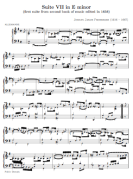
Source: IMSLP.org
Johann Jakob Froberger Books and Music
More on Froberger
Back to home page
Johann Jakob Froberger: Selected Recordings
6 Toccatas for Cembalo
Ricercar No. 5
Canzona 5 in G
Johann Jakob Froberger Books and Music
More on Froberger
Back to home page
 On Baroque
You must be logged in to post a comment.