I Libro di Capricci
Girolamo Frescobaldi Books and Music
More on Frescobaldi
Back to home page
I Libro di Capricci
Girolamo Frescobaldi Books and Music
More on Frescobaldi
Back to home page
“The development of instrumental music was a major development of the Baroque period. In organ music, the Baroque era found a master in Girolamo Frescobaldi.”—David Ewen, The Complete Book of Classical Music
Girolamo Frescobaldi is widely regarded as one of the most important composers of keyboard music in the early Baroque period. A child prodigy, his printed collections contain some of the most influential music of the 17th century. His work influenced Johann Jakob Froberger, Johann Sebastian Bach, and Henry Purcell, among others. He’s considered the first of the great composers of the ancient Franco-Netherlandish-Italian tradition who chose to focus his creative energy on instrumental composition. He brought a wide range of emotion to the relatively unplumbed depths of instrumental music, mostly for keyboard. He lived from September 1583 to March 1, 1643.—Excerpted from Wikipedia
Girolamo Frescobaldi Books and Music
More on Frescobaldi
Back to home page
The following list is excerpted from Wikipedia:
Keyboard music
A single posthumous print consisting entirely of unpublished music:
Frescobaldi’s works also appeared in the Nova instructio pro pulsandis organis, spinettis, manuchordiis series of prints in the 1670s.
Manuscript sources for Frescobaldi’s keyboard music include the following:
And finally, the so-called Chigi manuscripts include one (Rvat Chigi Q.IV) which is partly an autograph source and contains numerous works, including a number of unique copies (as well as a number of pieces with insecure attribution to Frescobaldi).
Other instrumental music
Vocal music
Additionally, a few pieces were published in anthologies:
Two polychoral masses are attributed to Frescobaldi by some scholars, but the attribution remains controversial:
—Excerpted from Wikipedia
Girolamo Frescobaldi Books and Music
More on Frescobaldi
Back to home page
Selected Books
Girolamo Frescobaldi
Harvard Univ. Press, 1983
Frederick Hammond
$139.95 on Amazon

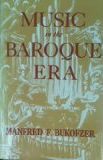
Music in the Baroque Era: From Monteverdi to Bach
W.W. Norton, 1947
Manfred Bukofzer
$39.95 on Amazon
Selected Music
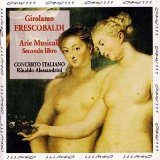 Arie Musicali, Book 2 (2000)
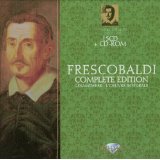 Complete Edition (2011)
 Canzoni (2004)

Il Primo Libro di Ricercari
Aria e Corrente
Il Primo Libro delle Canzoni, Part 2
Ave Virgo gloriosa

Source: IMSLP.org
I Libro di Capricci
“The development of instrumental music was a major development of the Baroque period. In organ music, the Baroque era found a master in Girolamo Frescobaldi.”—David Ewen, The Complete Book of Classical Music
Girolamo Frescobaldi is widely regarded as one of the most important composers of keyboard music in the early Baroque period. A child prodigy, his printed collections contain some of the most influential music of the 17th century. His work influenced Johann Jakob Froberger, Johann Sebastian Bach, and Henry Purcell, among others. He’s considered the first of the great composers of the ancient Franco-Netherlandish-Italian tradition who chose to focus his creative energy on instrumental composition. He brought a wide range of emotion to the relatively unplumbed depths of instrumental music, mostly for keyboard. He lived from September 1583 to March 1, 1643.—Excerpted from Wikipedia
Selected Books
Girolamo Frescobaldi
Harvard Univ. Press, 1983
Frederick Hammond
$139.95 on Amazon

Music in the Baroque Era: From Monteverdi to Bach
W.W. Norton, 1947
Manfred Bukofzer
$39.95 on Amazon
Selected Music
 Arie Musicali, Book 2 (2000)
 Complete Edition (2011)
Canzoni (2004)
More Girolamo Frescobaldi music
The following list is excerpted from Wikipedia:
Keyboard music
A single posthumous print consisting entirely of unpublished music:
Frescobaldi’s works also appeared in the Nova instructio pro pulsandis organis, spinettis, manuchordiis series of prints in the 1670s.
Manuscript sources for Frescobaldi’s keyboard music include the following:
And finally, the so-called Chigi manuscripts include one (Rvat Chigi Q.IV) which is partly an autograph source and contains numerous works, including a number of unique copies (as well as a number of pieces with insecure attribution to Frescobaldi).
Other instrumental music
Vocal music
Additionally, a few pieces were published in anthologies:
Two polychoral masses are attributed to Frescobaldi by some scholars, but the attribution remains controversial:
—Excerpted from Wikipedia
Psalm 119 Schwanengesang
Kleine geistlichen Concerten Op.9
Symphoniae Sacrae III, Op. 12
Heinrich Schütz Books and Music
More on Schütz
Back to home page
Psalms of David
Heinrich Schütz Books and Music
More on Schütz
Back to home page
“Heinrich Schütz was Germany’s most significant composer before the age of Bach and Handel. He represents the transition between not only two epochs but also two cultures.”—David Ewen, The Complete Book of Classical Music
Schütz was a German composer and organist, generally regarded as the most important German composer before Johann Sebastian Bach and often considered to be one of the most important composers of the 17th century along with Claudio Monteverdi. He wrote what is traditionally considered to be the first German opera, Dafne, performed at Torgau in 1627, the music of which has since been lost.
Schütz’s compositions show the influence of his teacher Gabrieli (displayed most notably with Schütz’s use of polychoral and concertato styles) and of Monteverdi. Additionally, the influence of the Netherlandish composers of the 16th century is prominent in his work. His best known works are in the field of sacred music, ranging from solo voice with instrumental accompaniment to a cappella choral music. Representative works include his three books of Symphoniae sacrae, the Psalms of David, the Sieben Worte Jesu Christi am Kreuz (the Seven Last Words on the Cross), and his three Passion settings.
Schütz’s music, while starting off in the most progressive styles early in his career, eventually grew into a style that is simple and almost austere, culminating with his late Passion settings.
He was one of the last composers to write in a modal style. His harmonies often result from the contrapuntal alignment of voices rather than from any sense of “harmonic motion”; contrastingly, much of his music shows a strong tonal pull when approaching cadences. His music includes a great deal of imitation, but structured in such a way that the successive voices do not necessarily enter after the same number of beats or at predictable intervallic distances.
Schütz’s writing often includes intense dissonances caused by the contrapuntal motion of voices moving in correct individual linear motion, but resulting in harmonic tension. Above all, his music displays sensitivity to the accents and meaning of the text, which is often conveyed using special technical figures drawn from musica poetica, themselves drawn from or created in analogy to the verbal figures of classical rhetoric.
Beyond the early book of madrigals, almost no secular music by Schütz has survived, save for a few domestic songs (arien) and no purely instrumental music at all (unless one counts the short instrumental movement entitled “sinfonia” that encloses the dialogue of Die sieben Worte), even though he had a reputation as one of the finest organists in Germany.
Schütz was of great importance in bringing new musical ideas to Germany from Italy, and as such had a large influence on the German music which was to follow. The style of the North German organ school derives largely from him. A century later this music was to culminate in the work of J.S. Bach. He lived from October 18, 1585, to November 18, 1672.—Excerpted from Wikipedia
Heinrich Schütz Books and Music
More on Schütz
Back to home page
The following are major published works. Access complete list on Wikipedia. There are more than 500 surviving pieces in all.
Heinrich Schütz Books and Music
More on Schütz
Back to home page


 On Baroque
You must be logged in to post a comment.