Fuga con 4 Soggetti

Source: IMSLP.org
Francesco Maria Veracini Books and Music
More on Veracini
Back to home page
Fuga con 4 Soggetti
Source: IMSLP.org
Francesco Maria Veracini Books and Music
More on Veracini
Back to home page
Sonata in G minor Part 1
Francesco Maria Veracini Books and Music
More on Veracini
Back to home page
Francesco Maria Veracini was an Italian composer and violinist, perhaps best known for his sets of violin sonatas. In addition to violin sonatas, operas and oratorios, Veracini also wrote violin concertos, sonatas for recorder and basso continuo, and orchestral suites, called Overtures. The six Overtures were performed for Prince Friedrich August in Venice in 1716, as part of Veracini’s ultimately successful attempt to secure a position at the Dresden court. They are all either in F major or B-flat major, except for one in G minor. The last one of these, in B-flat major, is remarkable for concluding with a unison minuet. Veracini also wrote a theory treatise, Il trionfo della pratica musicale (The Triumph of Musical Practice), and edited other composers’ works, adding changes of his own, such as he did in his Dissertazioni with the Opus 5 Violin Sonatas of Arcangelo Corelli.
There is a legend that, when Giuseppe Tartini heard Veracini playing the violin in 1712, he was so impressed by his bowing technique, and so dissatisfied with his own skill, that he retreated the next day to Ancona “in order to study the use of the bow in more tranquility, and with more convenience than at Venice,” where he had a place assigned him in the opera orchestra of that city. Veracini lived from February 1, 1690, to October 31, 1768.—Excerpted from Wikipedia
Francesco Maria Veracini Books and Music
More on Veracini
Back to home page
12 Sonatas for recorder or violin solo and basso (no opus number, dedicated to Prince Friedrich August, before 1716)
Opus 1, 12 Sonatas for violin solo and basso (dedicated to Prince Friedrich August, 1721)
Opus 2, 12 Sonate Accademiche for violin solo and basso (1744)
Dissertazioni del Sigr. Francesco Veracini sopra l’opera quinta del Corelli [Dissertation by Mr. Francesco Veracini on Corelli’s Opus 5] (date of composition uncertain, unpublished until 1961)
Opus 3, Il trionfo della pratica musicale, osia Il maestro dell’arte scientifica dal quale imparsi non solo il contrapunto ma (quel che più importa) insegna ancore con nuovo e facile metodo l’ordine vero di comporre in musica (music-theory treatise, 1760)—Excerpted from Wikipedia
Francesco Maria Veracini Books and Music
More on Veracini
Back to home page
Selected Books
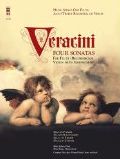
Music Minus One Flute, Recorder, or Violin
Music Minus One, 2001
Francesco Maria Veracini
$23.73 on Amazon
Selected Music
 Overtures Nos. 1 – 4 & 6 (1995)
 Dissertations Over Opera V O (2005)
 Sonate Accademiche (1995)

Sonata in A minor Part 1
Sonata in A minor Part 2
Overture Suite No.1 in B flat major
Fuga con 4 Soggetti
Source: IMSLP.org
Sonata in G minor Part 1
Francesco Maria Veracini was an Italian composer and violinist, perhaps best known for his sets of violin sonatas. In addition to violin sonatas, operas and oratorios, Veracini also wrote violin concertos, sonatas for recorder and basso continuo, and orchestral suites, called Overtures. The six Overtures were performed for Prince Friedrich August in Venice in 1716, as part of Veracini’s ultimately successful attempt to secure a position at the Dresden court. They are all either in F major or B-flat major, except for one in G minor. The last one of these, in B-flat major, is remarkable for concluding with a unison minuet. Veracini also wrote a theory treatise, Il trionfo della pratica musicale (The Triumph of Musical Practice), and edited other composers’ works, adding changes of his own, such as he did in his Dissertazioni with the Opus 5 Violin Sonatas of Arcangelo Corelli.
There is a legend that, when Giuseppe Tartini heard Veracini playing the violin in 1712, he was so impressed by his bowing technique, and so dissatisfied with his own skill, that he retreated the next day to Ancona “in order to study the use of the bow in more tranquility, and with more convenience than at Venice,” where he had a place assigned him in the opera orchestra of that city. Veracini lived from February 1, 1690, to October 31, 1768.—Excerpted from Wikipedia
Selected Books
Music Minus One Flute, Recorder, or Violin
Music Minus One, 2001
Francesco Maria Veracini
$23.73 on Amazon
Selected Music
 Overtures Nos. 1 – 4 & 6 (1995)
 Dissertations Over Opera V O (2005)
 Sonate Accademiche (1995)
More Francesco Maria Veracini music
12 Sonatas for recorder or violin solo and basso (no opus number, dedicated to Prince Friedrich August, before 1716)
Opus 1, 12 Sonatas for violin solo and basso (dedicated to Prince Friedrich August, 1721)
Opus 2, 12 Sonate Accademiche for violin solo and basso (1744)
Dissertazioni del Sigr. Francesco Veracini sopra l’opera quinta del Corelli [Dissertation by Mr. Francesco Veracini on Corelli’s Opus 5] (date of composition uncertain, unpublished until 1961)
Opus 3, Il trionfo della pratica musicale, osia Il maestro dell’arte scientifica dal quale imparsi non solo il contrapunto ma (quel che più importa) insegna ancore con nuovo e facile metodo l’ordine vero di comporre in musica (music-theory treatise, 1760)—Excerpted from Wikipedia
Concerto Grosso “Per il Santissimo Natale”
Sinfonia in A Minor Op. 5 No. 1
Sonate a cinque
Giuseppe Torelli Books and Music
More on Torelli
Back to home page
Concerti grossi con una pastorale, Op.8

Source: IMSLP.org
Giuseppe Torelli Books and Music
More on Torelli
Back to home page
Sonata for trumpet in D major G. 1
Giuseppe Torelli Books and Music
More on Torelli
Back to home page
Giuseppe Torelli’s 12 concerti of opus 8 “constitute one of the great achievements of the Baroque period. The principal traits that mark the mature concerto are here displayed: the fast-slow-fast sequence of movements, the ritornello form, and the virtuoso flights of the soloists.”—Claude Palisca, Baroque Music
Giuseppe Torelli was an Italian violist, violinist, teacher, and composer. He’s most remembered for his contributions to the development of the instrumental concerto, especially concerti grossi and the solo concerto, for strings and continuo, as well as being a prolific Baroque composer for trumpets. He was born in Verona. He studied composition with Giacomo Antonio Perti, and in 1684, at the age of 26, he became a member of the Accademia Filarmonica as suonatore di violino. By 1698 he was maestro di concerto at the court of Georg Friedrich II. He returned to Bologna sometime before February 1701, when he is listed as a violinist in the newly re-formed cappella musicale at San Petronio, directed by his former composition teacher Perti. He died in Bologna in 1709, where his manuscripts are conserved in the San Petronio archives. Giuseppe’s brother, Felice Torelli, was a Bolognese painter of modest reputation, who went on to be a founding member of the Accademia Clementina. The most notable amongst Giuseppe’s many pupils was Francesco Manfredini. He lived from April 22, 1658, to February 8, 1709.—Excerpted from Wikipedia
Giuseppe Torelli Books and Music
More on Torelli
Back to home page


 On Baroque
You must be logged in to post a comment.