Sonata Op.2 No.15, ‘La Torriana’
Giovanni Legrenzi Books and Music
More on Legrenzi
Back to home page
Sonata Op.2 No.15, ‘La Torriana’
Giovanni Legrenzi Books and Music
More on Legrenzi
Back to home page
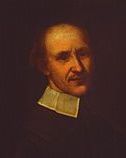
Giovanni Legrenzi was an Italian composer of opera, vocal, and instrumental music, and organist, of the Baroque era. He was one of the most prominent composers in Venice in the late 17th century, and extremely influential in the development of late Baroque idioms across northern Italy.
He was active in most of the genres current in northern Italy in the late 17th century, including sacred vocal music, opera, oratorio, and varieties of instrumental music. Though best known as a composer of instrumental sonatas, he was predominantly a composer of liturgical music with a distinctly dramatic character. The bulk of his instrumental music may also be included in this category, since it would have been used primarily as a substitute for liturgical items at Mass or Vespers. His operas were immensely popular (and extravagantly presented) in their day, though like his oratorios, few have survived. His later dance music was certainly connected with the operatic repertoire. He lived from August 12, 1626, to May 27, 1690.”—Excerpted from Wikipedia
a href=”https://onbaroque.com/2013/09/28/giovanni-legrenzi-books-and-music/”>Giovanni Legrenzi Books and Music
More on Legrenzi
Back to home page
Published works
Concerti Musicali per uso di Chiesa
Sonata a due, e tre
Harmonia d’affetti Devoti a due, tre, e quatro, voci
Sonate dà Chiesa, e dà Camera, Correnti, Balletti, Alemane, Sarabande a tre, doi violini, e violone. Libro Secondo
Salmi a cinque, tre voci, e due violini
Sentimenti Devoti Espressi con le musica di due, e tre voci. Libro Secondo
Compiete con le Lettanie & Antifone Della B.V. a 5. voci
Sonate a due, tre, cinque, a sei stromenti. Libro 3
Sacri e Festivi Concerti. Messa e Salmi a due chori con stromenti a beneplacito
Acclamationi Divote a voce sola. Libro Primo
La Cetra. Libro Quarto di Sonate a due tre e quattro stromenti
Cantate, e Canzonette a voce sola
Idee Armoniche Estese per due e tre voci
Echi di Riverenza di Cantate, e Canzoni. Libro Secondo
Sacri Musicali Concerti a due, e tre voci. Libro Terzo
Balletti e Correnti a cinque stromenti, con il basso continuo per il cembalo. Libro Quinto Postumo
Motetti Sacri a voce sola con tre strumenti
Unpublished works
The Messa a cinque voci con stromenti
The unaccompanied Missa quinque vocibus
The Messa a 16 for four choirs and organ continuo
The Prosa pro mortuis, including “Dies irae”
Intret in conspectu, a motet for 6 voices
Credidi propter quod locutus sum, a psalm setting for solo alto
Laudate pueri, a psalm setting for five voices
Spirate aure serenae, a motet for solo soprano
Legrenzi also composed numerous operas and oratorios. Among them:
Operas
Nino, il giusto
Achille in Sciro
Zenobia e Radamisto
Tiridate
Oratorios
Oratorio del giuditio
Oratorio della passione
Sedecia
Il creation del mondo––A complete list is on Wikipedia
Giovanni Legrenzi Books and Music
More on Legrenzi
Back to home page
Selected Books
Sonate für vier Violinen mit Basso continuo
Bärenreiter-Verlag, 1951 (sheet music)
$49.99 on Amazon

Selected Music
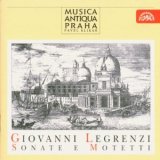 Sonatas and Motets (1997)
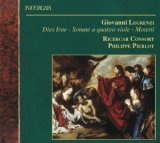 Dies Irae (2005)
 II Sedecia (2012)
Sonata ‘La Mosta’
L’Arpeggiata
Dies Irae
18 trio sonatas, op. 2
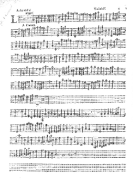
Source: IMSLP.org
Sonata Op.2 No.15, ‘La Torriana’
Giovanni Legrenzi was an Italian composer of opera, vocal, and instrumental music, and organist, of the Baroque era. He was one of the most prominent composers in Venice in the late 17th century, and extremely influential in the development of late Baroque idioms across northern Italy.
He was active in most of the genres current in northern Italy in the late 17th century, including sacred vocal music, opera, oratorio, and varieties of instrumental music. Though best known as a composer of instrumental sonatas, he was predominantly a composer of liturgical music with a distinctly dramatic character. The bulk of his instrumental music may also be included in this category, since it would have been used primarily as a substitute for liturgical items at Mass or Vespers. His operas were immensely popular (and extravagantly presented) in their day, though like his oratorios, few have survived. His later dance music was certainly connected with the operatic repertoire. He lived from August 12, 1626, to May 27, 1690.”—Excerpted from Wikipedia
Selected Books
Sonate für vier Violinen mit Basso continuo
Bärenreiter-Verlag, 1951 (sheet music)
$49.99 on Amazon
Selected Music
Sonatas and Motets (1997)
Dies Irae (2005)
II Sedecia (2012)
Published works
Concerti Musicali per uso di Chiesa
Sonata a due, e tre
Harmonia d’affetti Devoti a due, tre, e quatro, voci
Sonate dà Chiesa, e dà Camera, Correnti, Balletti, Alemane, Sarabande a tre, doi violini, e violone. Libro Secondo
Salmi a cinque, tre voci, e due violini
Sentimenti Devoti Espressi con le musica di due, e tre voci. Libro Secondo
Compiete con le Lettanie & Antifone Della B.V. a 5. voci
Sonate a due, tre, cinque, a sei stromenti. Libro 3
Sacri e Festivi Concerti. Messa e Salmi a due chori con stromenti a beneplacito
Acclamationi Divote a voce sola. Libro Primo
La Cetra. Libro Quarto di Sonate a due tre e quattro stromenti
Cantate, e Canzonette a voce sola
Idee Armoniche Estese per due e tre voci
Echi di Riverenza di Cantate, e Canzoni. Libro Secondo
Sacri Musicali Concerti a due, e tre voci. Libro Terzo
Balletti e Correnti a cinque stromenti, con il basso continuo per il cembalo. Libro Quinto Postumo
Motetti Sacri a voce sola con tre strumenti
Unpublished works
The Messa a cinque voci con stromenti
The unaccompanied Missa quinque vocibus
The Messa a 16 for four choirs and organ continuo
The Prosa pro mortuis, including “Dies irae”
Intret in conspectu, a motet for 6 voices
Credidi propter quod locutus sum, a psalm setting for solo alto
Laudate pueri, a psalm setting for five voices
Spirate aure serenae, a motet for solo soprano
Legrenzi also composed numerous operas and oratorios. Among them:
Operas
Nino, il giusto
Achille in Sciro
Zenobia e Radamisto
Tiridate
Oratorios
Oratorio del giuditio
Oratorio della passione
Sedecia
Il creation del mondo––A complete list is on Wikipedia
Today is the 328th anniversary of Ignazio Albertini’s death, making it a fitting time to take stock of this mysterious, troubled, yet clearly gifted Baroque composer who could have contributed so much to Western art had he only—not been murdered on Sept. 22, 1685.
Albertini was an Italian violinist who moved to Vienna and became part of the inner circle of Johann Heinrich Schmelzer, then one of the violin greats of he Viennese court.
What’s intresting about Albertini is how clearly gifted he was as a composer, based on his one surviving piece of work, a set of 12 violin sonatas that channel the color, imagination, and technical sophistication of Schmelzer as well as another contemporary violin great, Heinrich Biber, and yet how apparently troubled he was. 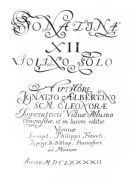
When he first appears in the written record, in an exchange of letters between Schmelzer and Karl II von Liechtenstein-Kastelkorn, Prince-Bishop of Olomouc, both Shmelzer and Karl II are admiring of his talent, but their written dialogue is in the context of some apparent misconduct he was accused of. It’s not clear what trouble Albertini was in, but it sounds like the good word of Schmelzer and Karl II helped put Albertini in a positive enough light that he later entered the service of Eleanor Gonzaga, widow of Ferdinand III, as chamber musician, and held that position until his death.
And about that death: he was stabbed, the victim of a murder. So, what you get is a picture of a talented artist with a messy personal life, not unlike so many rock and jazz stars, many of whom have ended up on the receiving end of a weapon, like Harry Womack of the Valentinos, who was stabbed by his girlfriend.  Or even like Bobby Fuller of the Bobby Fuller Four, probably best known for his hit “I fought the law and the law won,” who was shot in his car. His death is listed as a suicide but there’s enough messiness around the facts that it remains an open question whether someone else didn’t pull the trigger.
In any case, artists lives are often messy, a price of being gifted sometimes, and Albertini would seem to fit that mold. His surviving 12 sonatas suggest there could have been some memorable music added to our cultural heritage had he kept his life pulled together a bit more.
So, with that, here’s acknowledgement of Albertini’s fine work on this, the 328th aniversary of his death.—Nabob, On Baroque
Listen to one of the sonatas of Ignazio Albertini here:

Sonatinae title page
Sonata No. 1
Sonata No. 5
Sonata No. 10
Sonata No. 3

Source: IMSLP.org
Ignazio Albertini (Albertino) was an Italian Baroque violinist and composer. He is known by a single collection of music, the twelve Sonatinae (sonatas for violin and basso continuo) posthumously published in Vienna and in Frankfurt in 1692. The collection was prepared for publication by Albertini himself, but he did not live to see it printed.
His sonatas are multi-sectional pieces, very varied in content and structure, and all of the highest quality. Some idea of the rich variety of forms found in the Sonatinae may be gleaned from the following examples: Sonata IX is a passacaglia in which the main theme is presented as a canon at the fifth in the first and the last sections; and statements of the ostinato sometimes overlap with formal sections of the sonata. Sonata XII, the last in the cycle, consists entirely of imitative movements, unlike other sonatas, in which imitative movements are either absent or are surrounded by free sections, such as slow lyrical arias, toccata-like movements with rapid passagework over sustained bass notes, etc.
Albertini’s sonatas are very demanding technically, with frequent instances of difficult fast passages, leaps, sudden changes of register and, particularly in the last sonata, double stopping. He lived from c. 1644 to September 22, 1685.—Excerpted from Wikipedia
Like Schmelzer (and Biber, Westhoff, Strungk, and Walther among others) Albertini frequently downplays the dance in favor of more colorful and technically challenging free-form invention. In particular, the First, Fourth, Eighth, and 11th sonatas designated here (Albertini did not arrange them in any fixed order) include passages where the composer’s imaginative use of phrasing, dynamics, and ascending and descending scales is on par with his mentors.—Excerpted from Classics Today
Very little is known about his life, but he knew Johann Heinrich Schmelzer, one of the most important musicians at the Viennese court at the time, because Schmelzer in 1671 wrote a letter on Albertini’s behalf in praise of his musucianship. The letter was intended to help address some misconduct that Albertini was apparently accused of. Possibly as a result of some additional misconduct, Albertini died 14 years alter, in Vienna, the apparent victim of a stabbing. Read the On Baroque appreciation on the 328th anniversary of Albertini’s stabbing death.
Selected Music
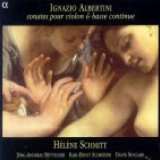 Sonates pour violon & bass continue (2002)
Twelve Sonatinae
Sonata hyllaris ex C à 10 (lost)
suite of 7 pieces à 4 (lost)

Aria con Variazioni
Sonata for Violin and B.C. No.7 in A minor
Sonata for violin, parts 9 & 10
XII Sonate da Camera a Violino

Source: IMSLP.org
Giovanni Stefano Carbonelli was one of the leading Italian violinist-composers active in London during the era of Handel. Reportedly a pupil of Corelli in Rome, he arrived in London in or before 1719, worked for a decade as leader of the orchestra at the Theatre Royal, Drury Lane, and subsequently became a successful freelance violinist in great public esteem, whose activity extended to at least 1762. Converting to Anglicanism, Carbonelli married in 1730; in 1735 he was naturalized under the name of John Stephen Carbonell.
From the Journal of the House of Lourdes for Feb. 1735:
“Persons sworn, to be naturalized. Henry Wilckens, John Barnard Hoffshleger, Loth Specht, Wolfert Van Hemert, Noah Blisson, Peter Le Maistre, Diederick William Toderhorst, John Stephen Carbonell, and Misael alias Remon Malfalguerat, took the Oaths appointed, in order to their Naturalization.”
From the 1740s, if not earlier, he also operated as a wine merchant, becoming in 1759 an official purveyor of wine to the King [George II]. His descendants continued the wine business highly successfully for several generations. His main patron was John Manners, 3rd Duke of Rutland, to whom, in 1729, he dedicated his sole surviving music, a privately published set of twelve violin sonatas entitled Sonate da camera a violino e violone o cembalo (1729). Such is the musical quality of these sonatas that their neglect until very recently is hard to explain, but the rather grudging approval accorded to them by the historian Charles Burney (1789) and the lack of any further surviving works by Carbonelli may be the main causes. He lived from 1699 or 1700 to 1773.—Excerpted from Edition HH
According to the Museum of London, a wine bottle during the period in which Carbonella was a wine merchant looked something like this: 
Selected Books
The Cambridge Companion to the Violin
Cambridge University Press, 1993
Robin Stowell
$34.19 on Amazon

“A great reference book that helped me gather information I couldn’t find online. Well organized and written, it should be on every violinist’s bookshelf.”—Paula on Amazon
Selected Music
 Sonates pour violin & basse continue (2003)
1. Violin Sonata No. 10 in G minor: I. Largo
2. Violin Sonata No. 10 in G minor: II. Allegro
3. Violin Sonata No. 10 in G minor: III. Largo
4. Violin Sonata No. 10 in G minor: IV. Giga
5. Violin Sonata No. 1 in D major: I. Adagio
6. Violin Sonata No. 1 in D major: II. Andante
7. Violin Sonata No. 1 in D major: III. Largo
8. Violin Sonata No. 1 in D major: IV. Allegro
9. Violin Sonata No. 12 in B minor: I. Largo
10. Violin Sonata No. 12 in B minor: II. Andante
11. Violin Sonata No. 12 in B minor: III. Aria con variazioni se piace
12. Prelude and Aria
13. Violin Sonata No. 7 in A minor: I. Largo
14. Violin Sonata No. 7 in A minor: II. Andante
15. Violin Sonata No. 7 in A minor: III. Adagio
16. Violin Sonata No. 7 in A minor: IV. Giga
17. Violin Sonata No. 6 in A major: I. Adagio, Allegro, Adagio
18. Violin Sonata No. 6 in A major: II. Allegro
19. Violin Sonata No. 6 in A major: III. Aria con variazioni se piace
Motetti
Maria Magdalena et altera Maria
Sulpitia Cesis Books and Music
More on Sulpitia Cesis
Back to home page

Image is not biographical
Motetti
Maria Magdalena et altera Maria
Maria Magdalena et Altera Maria

Source: Artemisia Editions
Sulpitia Lodovica Cesis was an Italian composer and well-regarded lutenist who was born in Modena, Italy, in 1577. She was a nun at the convent of Saint Geminiano in Modena, although some scholars report it as Saint Agostino. Her only known work is a volume of eight-part Motetti Spirituali, which she wrote in 1619, although some scholars think it might have been written earlier than that because of its style. It is composed of 23 motets for 2–12 voices.
Her work is different than other works written at this time because it contains indications for instruments such as cornetts, trombones, violones, and archviolones. A bass part exists as well, which is interesting considering that this music was written for a group of cloistered nuns. One explanation is that this part was for the organ or viola da gamba.
Cesis dedicated her collection to another nun of the same name, Anna Maria Cesis, who lived at the Convent of Santa Lucia in Rome. Both Sulpitia Cesis’s and Anna Maria Cesis’s convents were well known for their music.—Excerpted from Wikipedia
The Cesis collection of Motetti spirituali is an important body of music both for the generally high quality of the works it contains and for the information it provides regarding performance practice in Italian convents in the early seventeenth century.—Excerpted from Alexander Street
Selected Books
Divas in the Convent
Univ. of Chicago Press, 2012
Craig Monson
$17.49 on Amazon
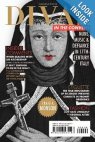
Nuns Behaving Badly
Univ. of Chicago Press, 2011
Craig Monson
$15.68 on Amazon

Selected Music
 Spiritual Motets (2003)
1. Hodie Gloriosus
2. Cantate Domino
3. Io So Ferito Si
4. Jubilate Deo
5. Il Mio Piu Vago Sole
6. Pecco Signore
7. Salve Gemma Confessorum
8. O Crux Splendidior
9. Cantemus Domino
10. Angelus Ad Pastores
11. Benedictus Dominus
12. Dulce Nomen Jesu Christe
13. Stabat Mater
14. Hic Est Beatissimus
15. Quest’e La Bella
16. O Domine Jesu Christe
17. Sub Tuum Praesidium
18. Maria Magdalena
19. Ecce Ego Joannes
20. Puer Qui Natus Est
21. Magi Videntes Stellam
22. Ascendo Ad Patrem
23. Parvulus Filius


 On Baroque
You must be logged in to post a comment.