Johann Caspar Ferdinand Fischer was a German Baroque composer. Johann Nikolaus Forkel, a Baroque-era music theorist, ranked Fischer as one of the best composers for keyboard of his day. However, partly due to the rarity of surviving copies of his music, his music is rarely heard today.
Much of Fischer’s music shows the influence of the French Baroque style, exemplified by Jean Baptiste Lully, and he was responsible for bringing the French influence to German music. Fischer’s harpsichord suites updated the standard model at the time, and he was also one of the first composers to apply the principles of the orchestral suite to the harpsichord, replacing the standard French ouverture with an unmeasured prelude. Both Bach and Handel knew Fischer’s work and sometimes borrowed from it. He lived from September 9, 1656, to August 27, 1746.—Excerpted from Wikipedia
Praeludium in F major
Praeludium in Phrygian Mode
Praeludium, Fuga et Finale in E minor
Praeludium, Fuga et Finale in G minor
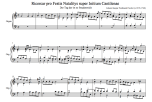
Ricercar pro Festis Natalytis
Ricercar pro Festis Paschalibus
Ricercar pro Festis Pentacostalibus
Ricercar pro tempore adventus
Ricercar pro Tempore Quadragesimae
Johann Caspar Ferdinand Fischer was a German Baroque composer. Johann Nikolaus Forkel, a Baroque-era music theorist, ranked Fischer as one of the best composers for keyboard of his day. However, partly due to the rarity of surviving copies of his music, his music is rarely heard today.
Much of Fischer’s music shows the influence of the French Baroque style, exemplified by Jean Baptiste Lully, and he was responsible for bringing the French influence to German music. Fischer’s harpsichord suites updated the standard model at the time, and he was also one of the first composers to apply the principles of the orchestral suite to the harpsichord, replacing the standard French ouverture with an unmeasured prelude. Both Bach and Handel knew Fischer’s work and sometimes borrowed from it. He lived from September 9, 1656, to August 27, 1746.—Excerpted from Wikipedia
Praeludium in F major
Praeludium in Phrygian Mode
Praeludium, Fuga et Finale in E minor
Praeludium, Fuga et Finale in G minor
Ricercar pro Festis Natalytis
Ricercar pro Festis Paschalibus
Ricercar pro Festis Pentacostalibus
Ricercar pro tempore adventus
Ricercar pro Tempore Quadragesimae
“The development of instrumental music was a major development of the Baroque period. In organ music, the Baroque era found a master in Girolamo Frescobaldi.”—David Ewen, The Complete Book of Classical Music
Girolamo Frescobaldi is widely regarded as one of the most important composers of keyboard music in the early Baroque period. A child prodigy, his printed collections contain some of the most influential music of the 17th century. His work influenced Johann Jakob Froberger, Johann Sebastian Bach, and Henry Purcell, among others. He’s considered the first of the great composers of the ancient Franco-Netherlandish-Italian tradition who chose to focus his creative energy on instrumental composition. He brought a wide range of emotion to the relatively unplumbed depths of instrumental music, mostly for keyboard. He lived from September 1583 to March 1, 1643.—Excerpted from Wikipedia
Il primo libro delle fantasie a quattro (Milan, 1608): 12 fantasies
Toccate e partite d’intavolatura di cimbalo, libro primo (Rome, 1615): 12 toccatas, 4 partitas, 4 correntes (revised in 1637 with additions)
Recercari et canzoni franzese fatte sopra diverse oblighi in partitura, libro primo (Rome, 1615): 10 ricercars, 5 canzonas
Il primo libro di capricci fatti sopra diversi soggetti et arie in partitura (Rome, 1624): 12 capriccios
Il secondo libro di toccate, canzone, versi d’hinni, Magnificat, gagliarde, correnti et altre partite d’intavolatura di cembalo et organo (Rome, 1627): 11 toccatas, 6 canzonas, 4 hymns, 3 Magnificats, 5 galliards, 6 correntes and 4 partitas (revised in 1637)
Fiori musicali di diverse compositioni, toccate, kyrie, canzoni, capricci, e recercari, in partitura (Venice, 1635): 3 organ masses, 2 capriccios
A single posthumous print consisting entirely of unpublished music:
Canzoni alla francese in partitura, [libro quarto] (Venice, 1645): 11 canzonas
Frescobaldi’s works also appeared in the Nova instructio pro pulsandis organis, spinettis, manuchordiis series of prints in the 1670s.
Manuscript sources for Frescobaldi’s keyboard music include the following:
Fioretti di Frescobaldi, GB-Lbl Add.40080: 11 canzonas, 1 toccata. This manuscript is in the hand of Nicolò Borbone, Frescobaldi’s assistant and engraver for the two books of toccatas.
And finally, the so-called Chigi manuscripts include one (Rvat Chigi Q.IV) which is partly an autograph source and contains numerous works, including a number of unique copies (as well as a number of pieces with insecure attribution to Frescobaldi). Other instrumental music
3 canzonas a 4, 5, and 8 (1608)
In partitura, il primo libro delle canzoni a 1–4, bc, per sonare con ogni sorte di stromenti (Rome, 1628): 38 ensemble canzonas, edited by . Two different editions appeared in 1628, one with 3 new works; a 1634 Venice print (Canzoni da sonare) contains 28 pieces, removing some of the old works and adding 10 new ones.
Vocal music
Il primo libro de’ madrigali (Antwerp, 1608): 19 madrigals for 5 voices
Liber secundus diversarum modulationum (Rome, 1627): 32 motets
Primo libro d’arie musicali per cantarsi (Florence, 1630): 23 arias for 1–3 voices and basso continuo
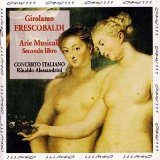
Secondo libro d’arie musicali per cantarsi (Florence, 1630): 20 arias for 1–3 voices and basso continuo
Additionally, a few pieces were published in anthologies:
Peccavi super numerum, motet for 3 voices and basso continuo (1616)
Angelus ad pastores, motet for 3 voices and basso continuo (1618)
Alla gloria alli honori, aria for 2 voices and basso continuo (1621)
Ego sum panis vivus, motet for 3 voices and basso continuo (1621)
O bell’occhi che guerrieri, aria for voice and basso continuo (1621)
Era l’anima mia, aria for 2 voices and basso continuo (1622)
Jesu rex admirabilis, motet for 4 voices and basso continuo (1625)
Two polychoral masses are attributed to Frescobaldi by some scholars, but the attribution remains controversial:


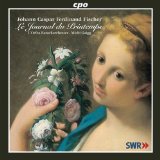
 , 1 CD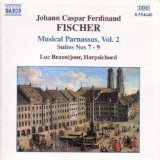
 , 1 CD
 , 1 CD



 , 1 CD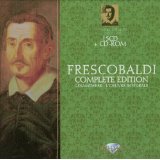
 , 15-CD set
 , 1 CD
 On Baroque
You must be logged in to post a comment.