Concerto Grosso Op. 6. No. 11
Hallelujah Chorus from Messiah
Water Music Suite No.1
George Frederic Handel Books and Music
More on Handel
Back to home page
Concerto Grosso Op. 6. No. 11
Hallelujah Chorus from Messiah
Water Music Suite No.1
George Frederic Handel Books and Music
More on Handel
Back to home page
Selected Books
Handel (Revised Edition)
Thames & Hudson, 2007
Christopher Hogwood
$19.76 on Amazon
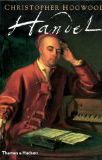
“This is by far the best {Handel biography], both for detail and accuracy and for sheer readability. With the help of a good deal of 18th (and sometimes 19th) century literature which he quotes verbatim whenever it seems appropriate (but without overburdening his text with footnotes), Christopher Hogwood takes five long chapters to describe in great fulness the known facts – and some speculative ones – of the life of Handel from his birth through to his death in London in 1759. Hogwood limits himself to narrative and does not begin interpreting Handel’s music, nor does he discuss in too much detail the ins and outs of when Handel changed this or that aria.”—Leslie Richford on Amazon
George Frideric Handel: Composer of Messiah
Mott Media, 1987
Charles Ludwig
$8.09 on Amazon

“This book was very imformative and a very easy read. Having the historical perspective along with the musical output was very interesting. It is always interesting to learn about the mindset of the composer along with the constraints he is faced with while he is producing his music. I would recommend this book very much.”—Marilyn Brace on Amazon
Selected Music
 The Messiah (2002)
 Music for the Royal Fireworks / Water Music (1990)
 Complete Violin Sonatas (2005)

Concerto Grosso Op. 6. No. 11
Hallelujah Chorus from Messiah
Water Music Suite No.1
Hallelujah chorus from Messiah

Source: CPDL.org
Largo
“Though George Frideric Handel’s best concerti grossi and orchestral suites is music of uncommon distinction, and though he filled his solo concerti and sonatas with the most infectious ideas, he is essentially a dramatic and not an instrumental composer. He gained his fame through operas—his immortality, through oratorios.”—David Ewen, The Complete Book of Classical Music
George Frideric Handel was a German-born British Baroque composer, famous for his operas, oratorios, anthems, and organ concertos. Handel was born in 1685, in a family indifferent to music. He received critical musical training in Halle, Hamburg, and Italy before settling in London in 1712 and becoming a naturalised British subject in 1727. By then he was strongly influenced by the great composers of the Italian Baroque and the middle-German polyphonic choral tradition.
Within fifteen years, Handel had started three commercial opera companies to supply the English nobility with Italian opera, but the public came to hear the vocal bravura of the soloists rather than the music. In 1737 he had a physical breakdown, changed direction creatively, and addressed the middle class and made a transition to English choral works. After his success with Messiah (1742) he never performed an Italian opera again. Handel was only partly successful with his performances of English oratorio on mythical and biblical themes, but when he arranged a performance of Messiah to benefit the Foundling Hospital (1750) the criticism ended. Almost blind, and having lived in England for almost fifty years, he died in 1759, a respected and rich man.
Handel is regarded as one of the greatest composers of all time, with works such as Water Music, Music for the Royal Fireworks, and Messiah remaining popular. Handel composed more than forty operas in over thirty years, and since the late 1960s, with the revival of baroque music and original instrumentation, interest in Handel’s operas has grown. He lived from February 23, 1685, to April 14, 1759.—Excerpted from Wikipedia
Selected Books
Handel (Revised Edition)
Thames & Hudson, 2007
Christopher Hogwood
$19.76 on Amazon

“This is by far the best {Handel biography], both for detail and accuracy and for sheer readability. With the help of a good deal of 18th (and sometimes 19th) century literature which he quotes verbatim whenever it seems appropriate (but without overburdening his text with footnotes), Christopher Hogwood takes five long chapters to describe in great fulness the known facts – and some speculative ones – of the life of Handel from his birth through to his death in London in 1759. Hogwood limits himself to narrative and does not begin interpreting Handel’s music, nor does he discuss in too much detail the ins and outs of when Handel changed this or that aria.”—Leslie Richford on Amazon
George Frideric Handel: Composer of Messiah
Mott Media, 1987
Charles Ludwig
$8.09 on Amazon

“This book was very imformative and a very easy read. Having the historical perspective along with the musical output was very interesting. It is always interesting to learn about the mindset of the composer along with the constraints he is faced with while he is producing his music. I would recommend this book very much.”—Marilyn Brace on Amazon
Selected Music
 The Messiah (2002)
 Music for the Royal Fireworks / Water Music (1990)
 Complete Violin Sonatas (2005)
More George Frederic Handel music
Handel’s compositions include 42 operas, 29 oratorios, more than 120 cantatas, trios, and duets, numerous arias, chamber music, a large number of ecumenical pieces, odes and serenatas, and 16 organ concerti.
His oratorio Messiah, with its “Hallelujah” chorus, is among the most famous Baroque works and is a popular choice for performances during the Christmas season. Among Handel’s best-known instrumental works are the Concerti Grossi Opus 3 and 6, “The Cuckoo and the Nightingale,” in which birds are heard calling during passages played in different keys representing the vocal ranges of two birds, and his 16 keyboard suites, especially The Harmonious Blacksmith.
Collected editions of Handel’s works include the Händel-Gesellschaft and the Hallische Händel-Ausgabe, however the more recent Händel-Werke-Verzeichnis publication is now commonly used to number his works. For example, Handel’s Messiah can be referred to as HG xlv, HHA i/17, or HWV 56. Some of Handel’s music is also numbered based on initial publications. For example, a 1741 publication by Walsh labelled twelve of Handel’s concerti grossi as Opus 6.—Excerpted from Wikipedia
Handel produced hundreds of pieces over his career. Access complete list on Wikipedia.
Access list of solo keyboard sonatas separately
The following is excerpted from Wikipedia:
Only a small fraction of Scarlatti’s compositions were published during his lifetime; Scarlatti himself seems to have overseen the publication in 1738 of the most famous collection, his 30 Essercizi (“Exercises”). These were rapturously received throughout Europe, and were championed by the foremost English writer on music of the eighteenth century, Charles Burney.
The many sonatas which were unpublished during Scarlatti’s lifetime have appeared in print irregularly in the two and a half centuries since. Scarlatti has attracted notable admirers, including Frédéric Chopin, Johannes Brahms, Béla Bartók, Dmitri Shostakovich, Heinrich Schenker, Vladimir Horowitz,Emil Gilels, Arturo Benedetti Michelangeli, and Marc-André Hamelin.
Scarlatti’s 555 keyboard sonatas are single movements, mostly in binary form, and mostly written for the harpsichord or the earliest pianofortes. (There are four for organ, and a few for small instrumental group). Some of them display harmonic audacity in their use of discords, and also unconventional modulations to remote keys.
Other distinctive attributes of Scarlatti’s style are the following:
Ralph Kirkpatrick produced an edition of the sonatas in 1953, and the numbering from this edition is now nearly always used – the Kk. or K. number. Previously, the numbering commonly used was from the 1906 edition compiled by the Neapolitan pianist Alessandro Longo (L. numbers). Kirkpatrick’s numbering is chronological, while Longo’s ordering is a result of his grouping the sonatas into “suites”. In 1967 the Italian musicologist Giorgio Pestelli published a revised catalogue (using P. numbers), which corrected what he considered to be some anachronisms.
Aside from his many sonatas, he composed a quantity of operas and cantatas, symphonias, and liturgical pieces. Well known works include the Stabat Mater of 1715 and the Salve Regina of 1757, which is thought to be his last composition.
Domenico Scarlatti Books and Music
More on Domenico Scarlatti
Back to home page
“In writing new music for the harpsichord, and in opening thereby new vistas for harpsichord performance, only Domenico Scarlatti can rival the significance of Couperin-le-Grand. It is by his remarkable harpsichord pieces that he has secured a historic place in music.”—David Ewen, The Complete Book of Classical Music
Giuseppe Domenico Scarlatti was an Italian composer who spent much of his life in the service of the Portuguese and Spanish royal families. He is classified as a Baroque composer chronologically, although his music was influential in the development of the Classical style. Like his renowned father Alessandro Scarlatti he composed in a variety of musical forms, although today he is known mainly for his 555 keyboard sonatas. He was the sixth of ten children of the composer and teacher Alessandro Scarlatti. He lived from October 26, 1685, to July 23, 1757.—Excerpted from Wikipedia
Domenico Scarlatti Books and Music
More on Domenico Scarlatti
Back to home page
Laudate Pueri

Source: CPDL.org
Domenico Scarlatti Books and Music
More on Domenico Scarlatti
Back to home page
Sonata em ré menor: L. 413—K. 9
Sonatas for Viola d’Amore and Cembalo
Sonata K. 119
Domenico Scarlatti Books and Music
More on Domenico Scarlatti
Back to home page
Selected Books
Domenico Scarlatti
Princeton University Press, 1983
Ralph Kirkpatrick
$8.97 used on Amazon
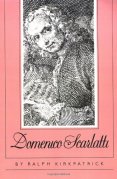
“Ralph Kirkpatrick’s 1953 work remains THE book on Domenico Scarlatti and his keyboard sonatas. There have been no substantial revisions in the biography of DS since 1953. Georgio Pestelli and many others have questioned Kirkpatrick on chronology, but when it comes to analysis of individual sonatas, Kirkpatrick is strong. And his performances speak well even 50 years later. Kirkpatrick was not a musicologist, so his book is actually interesting to read!”—Eloi on Amazon
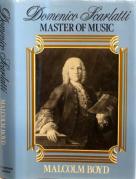
Domenico Scarlatti: Master of Music
Schirmer Books, 1987
Malcolm Boyd
$17.95 used on Amazon
Selected Music
 Keyboard Sonatas (2001)
 Stabat Mater a 10 voci (2002)
 Sonatas (1990)

Sonata em ré menor: L. 413—K. 9
Sonatas for Viola d’Amore and Cembalo
Sonata K. 119
Laudate Pueri
Source: CPDL.org
Sonata K. 380
“In writing new music for the harpsichord, and in opening thereby new vistas for harpsichord performance, only Domenico Scarlatti can rival the significance of Couperin-le-Grand. It is by his remarkable harpsichord pieces that he has secured a historic place in music.”—David Ewen, The Complete Book of Classical Music
Giuseppe Domenico Scarlatti was an Italian composer who spent much of his life in the service of the Portuguese and Spanish royal families. He is classified as a Baroque composer chronologically, although his music was influential in the development of the Classical style. Like his renowned father Alessandro Scarlatti he composed in a variety of musical forms, although today he is known mainly for his 555 keyboard sonatas. He was the sixth of ten children of the composer and teacher Alessandro Scarlatti. He lived from October 26, 1685, to July 23, 1757.—Excerpted from Wikipedia
Selected Books
Domenico Scarlatti
Princeton University Press, 1983
Ralph Kirkpatrick
$8.97 used on Amazon
“Ralph Kirkpatrick’s 1953 work remains THE book on Domenico Scarlatti and his keyboard sonatas. There have been no substantial revisions in the biography of DS since 1953. Georgio Pestelli and many others have questioned Kirkpatrick on chronology, but when it comes to analysis of individual sonatas, Kirkpatrick is strong. And his performances speak well even 50 years later. Kirkpatrick was not a musicologist, so his book is actually interesting to read!”—Eloi on Amazon
Domenico Scarlatti: Master of Music
Schirmer Books, 1987
Malcolm Boyd
$17.95 used on Amazon
Selected Music
Keyboard Sonatas (2001)
Stabat Mater a 10 voci (2002)
Sonatas (1990)
Access list of solo keyboard sonatas separately
The following is excerpted from Wikipedia:
Only a small fraction of Scarlatti’s compositions were published during his lifetime; Scarlatti himself seems to have overseen the publication in 1738 of the most famous collection, his 30 Essercizi (“Exercises”). These were rapturously received throughout Europe, and were championed by the foremost English writer on music of the eighteenth century, Charles Burney.
The many sonatas which were unpublished during Scarlatti’s lifetime have appeared in print irregularly in the two and a half centuries since. Scarlatti has attracted notable admirers, including Frédéric Chopin, Johannes Brahms, Béla Bartók, Dmitri Shostakovich, Heinrich Schenker, Vladimir Horowitz,Emil Gilels, Arturo Benedetti Michelangeli, and Marc-André Hamelin.
Scarlatti’s 555 keyboard sonatas are single movements, mostly in binary form, and mostly written for the harpsichord or the earliest pianofortes. (There are four for organ, and a few for small instrumental group). Some of them display harmonic audacity in their use of discords, and also unconventional modulations to remote keys.
Other distinctive attributes of Scarlatti’s style are the following:
Ralph Kirkpatrick produced an edition of the sonatas in 1953, and the numbering from this edition is now nearly always used – the Kk. or K. number. Previously, the numbering commonly used was from the 1906 edition compiled by the Neapolitan pianist Alessandro Longo (L. numbers). Kirkpatrick’s numbering is chronological, while Longo’s ordering is a result of his grouping the sonatas into “suites”. In 1967 the Italian musicologist Giorgio Pestelli published a revised catalogue (using P. numbers), which corrected what he considered to be some anachronisms.
Aside from his many sonatas, he composed a quantity of operas and cantatas, symphonias, and liturgical pieces. Well known works include the Stabat Mater of 1715 and the Salve Regina of 1757, which is thought to be his last composition.


 On Baroque
You must be logged in to post a comment.